

What the Ragam Carries
Kumaresh Rajagopalan on lyric, melody, and where the music actually lives.
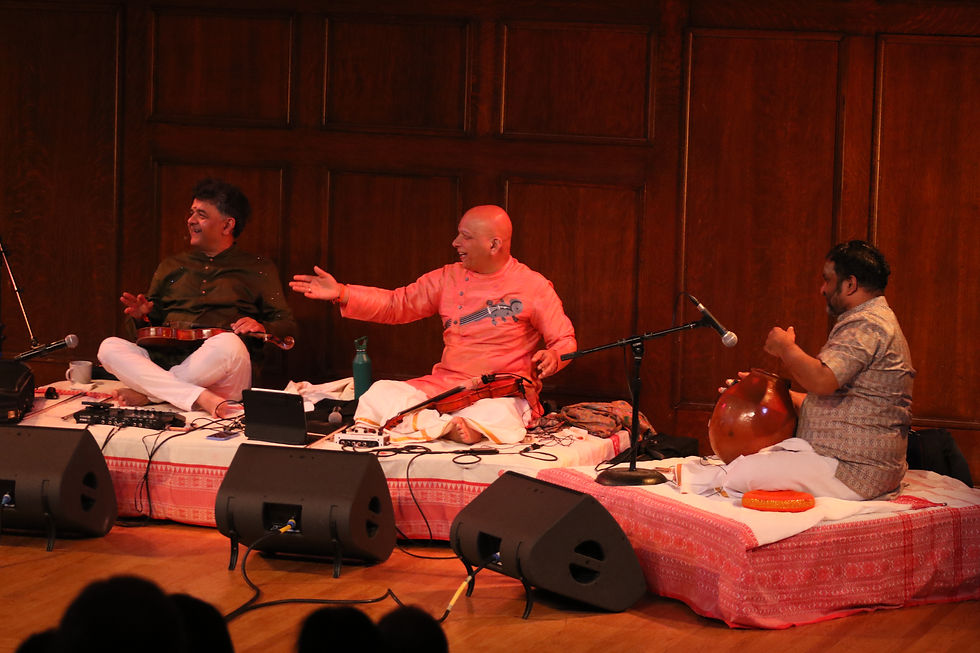
After the May 17th concert at The Sheldon, an audience member sent us an interesting question; he wanted to know: how important is it for an instrumentalist to know and understand the lyrics of a composition — the sahityam — in order to bring out its full emotional meaning, its bhavam? And can that meaning even be conveyed through note embellishment and nuance alone, without the words?
Sahityam refers to the lyrical text of a Carnatic composition — the words, in languages such as Sanskrit, Telugu, or Tamil, written by a composer like Tyagaraja or Purandara Dasa, that a vocalist sings. Bhavam is the emotional quality a piece is meant to carry — its feeling, its intent. The question was essentially asking: if you remove the words from the equation, does the feeling survive?
Kumaresh Rajagopalan had a specific answer, and he opened it with a single example.
He brought up Jagadanandakaraka, one of the most well-known compositions in the Carnatic repertoire — a Tyagaraja kriti in ragam Natai, sung in praise of Rama. The correct reading of the opening phrase is jagad-ananda-karaka: one who brings bliss to the world. But listen to how most vocalists actually render it today, Kumaresh pointed out, and you'll often hear the phrase split as jagada — nanda-karaka, with nandakaraka taking its own rhythmic emphasis. The problem: nandakaraka on its own is semantically incomplete. The meaning lives in anandakaraka — one who creates (karaka) joy (ananda). Split it the other way and the word dissolves.
And yet musicians do it anyway. Why? Because the split sounds better. The syllables land more "naturally,"& the phrase sits more comfortably in the music. The musical logic wins over the textual logic — and Kumaresh's point is that this isn't just an accident or a mistake. It's a reflection of where the aesthetic priority actually sits, even within the vocal tradition itself.
"If you look at the sahityam," he said, "the split is mainly musical and not lyrical. It is always the musical beauty as opposed to the lyric beauty."
There's another layer too — language. For example, a Telugu speaker hearing Jagadanandakaraka and a Tamil speaker hearing the same composition have different experiences — different levels of comprehension, different emotional proximity to the language. But both of them are hearing the same Nata ragam. The ragam, Kumaresh argued, is the common ground that language does not provide.
He made a related point through O Rangasayi, a deeply familiar piece to many in Kambodhi ragam. The lyrics connect, yes — but the connection, he suggested, is inseparable from the fact that it is that specific ragam and those oscillations and that tempo. The beauty is not the words sitting on top of the music. It is the music, and the words living inside it. Take out the melody and leave only the lyrics: the emotional experience collapses. Take out the lyrics and leave only the melody: the beauty holds.
This is not an argument that lyrics are incidental. It is a more precise argument about what gives them their power. The ragam, in Kumaresh's view, is not a vehicle for the sahityam. The sahityam is a vehicle for the ragam.
Whether that lands as revelation or provocation likely depends on where you're sitting — as a listener, as a musician, as someone who speaks the language of the composition or doesn't. The audience member who asked the question was trying to understand how an instrumentalist can move you the way a vocalist does, even without a single word. Kumaresh's answer, essentially, is that the instrumentalist has the same thing the vocalist has — the ragam — and that may be the only thing that was ever doing the work.
A note from Lekha
The perspectives shared here are those of the artist, offered in response to a question from the audience at Janya's May 17th concert at The Sheldon. Lekha presents them as part of an ongoing conversation about the music — not as positions endorsed by Janya or Lekha.


Comments