

A Different Bhavam
Ganesh Rajagopalan on gamaka, the limits of comparison, and what instrumental music asks of its listeners
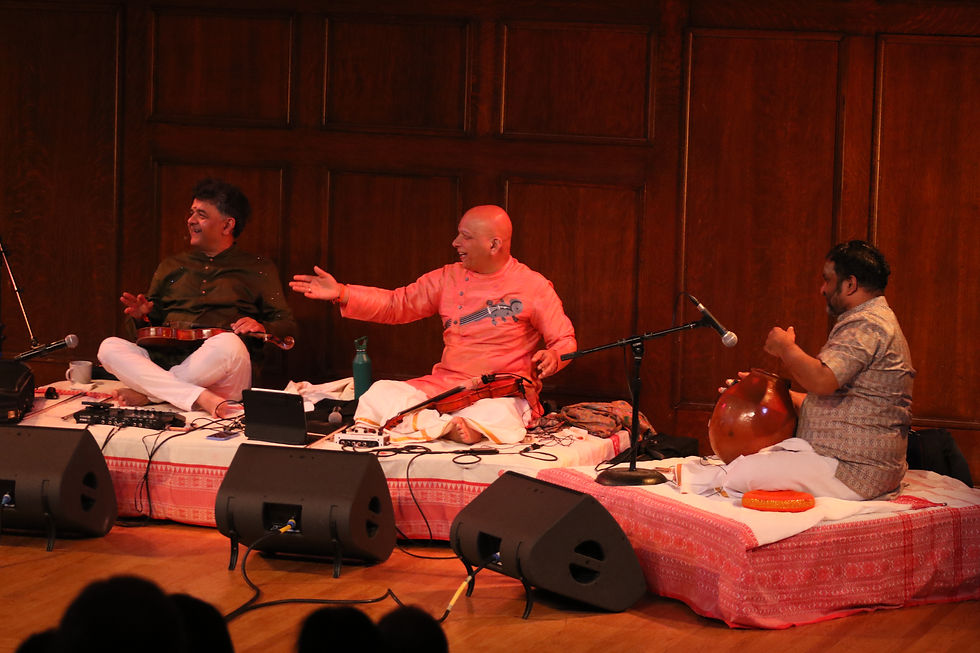
After the May 17th concert at The Sheldon, an audience member asked a question that cut to something fundamental. He wanted to know: how important is it for an instrumentalist to know and understand the lyrics — the sahityam — of a composition in order to bring out its full emotional meaning, its bhavam? And can that meaning be conveyed through note embellishment and nuance alone, without the words?
The same question was asked of both brothers -- but drew a different kind of response from Ganesh Rajagopalan.
Where his brother Kumaresh moved through the question by examining the vocal tradition itself — showing that even singers prioritize musical logic over textual fidelity — Ganesh approached it from the instrumentalist's side, and arrived at a more categorical position: sahitya bhavam, the emotional meaning carried by lyrics, is something that belongs more to vocalists and dancers. Instrumentalists aren't working in the same register. Comparing them isn't just imprecise. It's the wrong comparison entirely.
"Don't compare vocal and instrumental," he said. "It's like apples and oranges. Neither is better, they're just different."
For an instrumentalist, Ganesh argued, the vehicle of emotion is gamaka — the ornamentation & inflection applied to individual notes in Indian music. Gamaka is not decoration layered over a note. It is the primary technique by which a note becomes expressive, wherein a phrase takes on weight or lightness, urgency or repose.
A note played flat and a note played with gamaka carry different emotional content at the level of the sound itself. "If you really work on that impact," he said, "you don't necessarily need to know the lyrics."
This isn't a claim that lyrics are irrelevant to music. It's a claim about what kind of music we're talking about.
Lyrics, in the Carnatic tradition, can be seen as "fusions of thought" — they may carry theological meaning, narrative, or the specific perspective of a composer writing in a particular language to a particular deity. When a vocalist sings "O Rangasayi", the words are activating something in the listener that is partly linguistic, partly cultural, partly specific to those listeners who share the context. That specificity is part of what makes the vocal experience powerful. It is also, Ganesh pointed out, part of what makes it difficult to share.
"Instrumental music is global," he said. "Vocal is always parochial. Colloquial. So it causes a divide."
He was careful not to frame this as a hierarchy. The dominance of lyric-centered thinking in Carnatic music is not, in his view, the result of anyone's bad intention. "It's not intentional," Kumaresh added from across the table. "It's ignorance and the happening of times and other factors — in good faith, but it has limited the perspective." Each form, Ganesh said, has its own realm — and the difficulty arises when one is heard or analyzed through the other's lens.
What instrumental music offers, in this framing, is a different kind of access — one that doesn't require a shared language or context to work. That is not a lesser offer. It is simply a different one, operating by different means, asking something different of the audience.
Whether those are two paths to the same place, or two separate destinations, is a question neither brother fully settled — and probably not one that needs adjudication.
In their words, they ask us to rethink the entry point — and to allow the gamaka, phrase, and architecture of the ragam itself to be sufficient. Because for a listener who doesn't know the language of the composition, or who has no relationship to the text, the instrument is the more honest invitation. It doesn't ask for context. It simply asks for attention.
A note from Lekha
The perspectives shared here are those of the artist, offered in response to a question from the audience at Janya's May 17th concert at The Sheldon. Lekha presents them as part of an ongoing conversation about the music — not as positions endorsed by Janya or Lekha.


Comments