

In Conversation: Audience Q&A with Ramana Balachandhran and Patri Satish Kumar
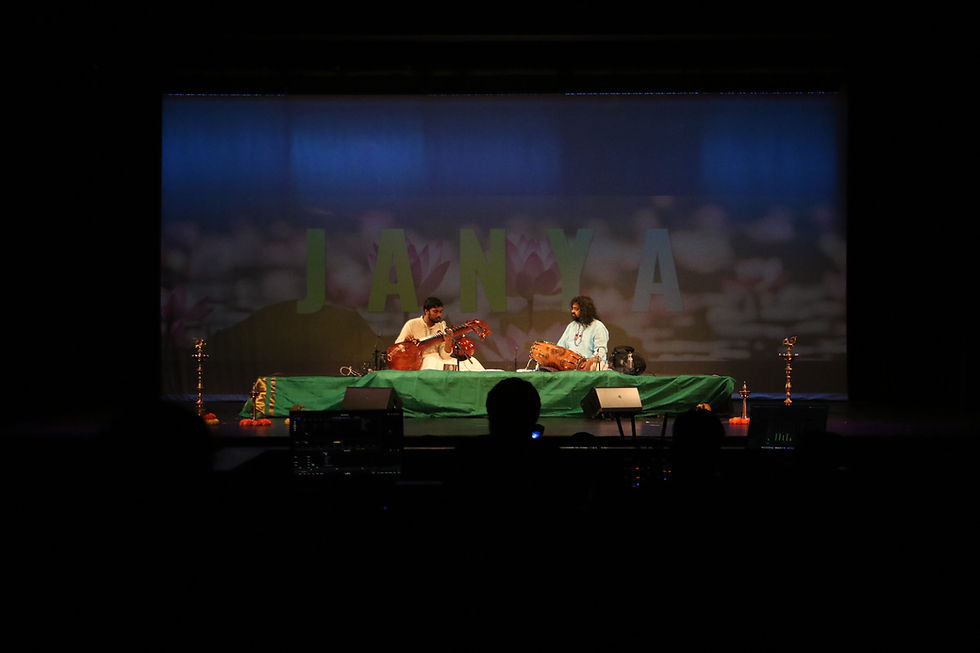
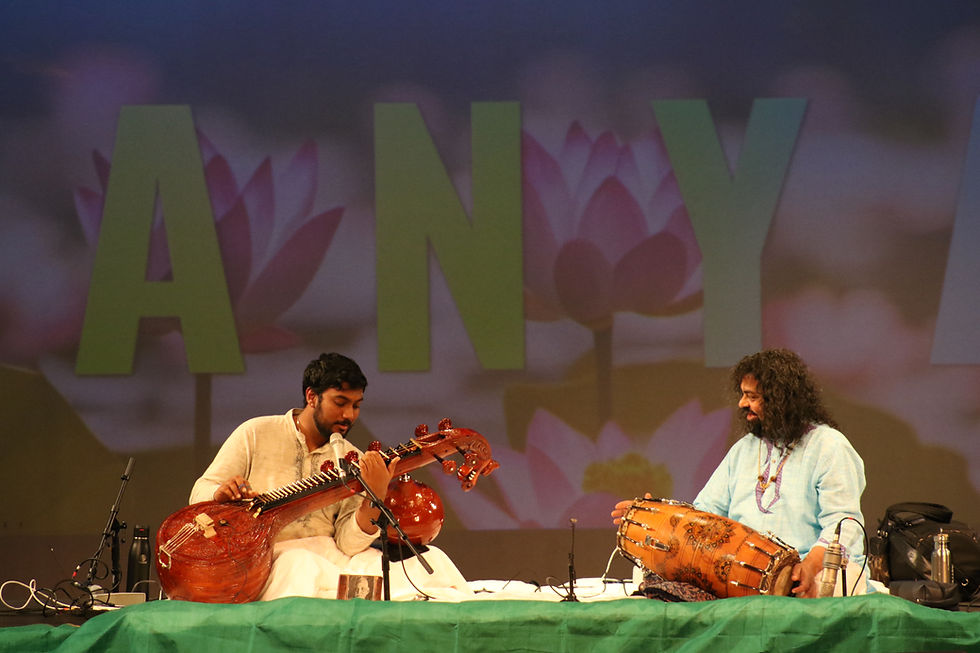
At the conclusion of the June 8 concert, we opened the floor to audience questions. What followed was a thoughtful, informal exchange — with questions ranging from raga evolution and pitch systems to teaching practice and emotional connection. Below is a full transcript of the discussion, lightly formatted for readability.
Q1: Are rāgas regional, or were they developed all at once?
Ramana Balachandhran:“Carnatic music primarily evolved in South India. Rāgas as we know them today have been shaped by generations of composers and musicians… the grammar itself is ever-dynamic, not fixed. There’s one school of thought that preserves rāga grammar as sacrosanct, and another that asks what each musician can contribute. I believe rāgas evolve through both preservation and reinvention.”
Q2: How do shrutis in Carnatic music compare to the 12-note systems in Hindustani and Western music?
Ramana Balachandhran:“I actually think there are infinite shrutis. I haven’t studied the 22-shruti theory in depth, but from experience — our music isn’t built on absolute frequencies. It’s built on oscillations, on waves. Even when demonstrating shrutis, it’s always as movement — not fixed pitches. You might oscillate between two semitones, but never ‘hit’ a precise note and stay there. So I don’t think of it as a finite set of notes at all. It’s about how notes are approached, left, or hovered around.”
Q3: How do you teach your students? Is it the same level of rigor you experienced?
Ramana Balachandhran:“I wouldn’t call myself a prodigy — not compared to artists like Mandolin Srinivas, Abhishek Raghuram, or Flute Shashank for example. I was given some gifts, but what helped was my father’s structure. He never left things to chance. Even with improvisation, we broke it into subtasks — it was problem-solving, not guesswork. I’m a very kind teacher — maybe too kind — but I try to help students think systematically about the music they’re learning.”
Q4: How does practice lead to spontaneity?
(Directed to Patri Satish Kumar)
Patri Satish Kumar:“First, it starts with listening — years of listening. You internalize what you hear. Then comes practice — and more importantly, reflection on what you’re practicing. That’s where spontaneity begins. The guru’s role is to help guide whether you’re moving in the right direction. Over time, the internal journey becomes self-driven — and in some cases, the student may even surpass the teacher.”
Q5: What was the dynamic between you two during the concert? Was it structured or spontaneous?
Ramana Balachandhran:“We weren’t performing. We were speaking to each other — in the language of our instruments.”Patri Satish Kumar:“Exactly. It wasn’t a presentation. It was a dialogue — a musical conversation that evolved moment by moment.”
Q6: How do you choose rāgams for a concert?
Ramana Balachandhran:“I was told that there would be a lot of listeners unfamiliar with Carnatic music, so I chose Desh — which is relatively accessible. Some ragas are intricate and take time to grow on you. Desh is more immediate. I also try to avoid rāgams that clash tonally, so the concert has a sense of movement and contrast.”
Q7: For someone new to this music — where does Carnatic music fit in Indian culture today?
Ramana Balachandhran:“It began in temples and homes — much of the repertoire is devotional in theme. Today, it also lives in sabhas and on stages, but its core themes still revolve around surrender, introspection, and mood. That hasn't changed.”
Let me know which of these you'd like to trim or restructure for publication, and I’ll preserve only the most journalistic excerpts while keeping it accurate. We can also create an abridged version with video timestamps or a “highlights-only” section for readers who want a quicker read.


Comments