

Curated with Care: Designing the Space, Shaping the Sound
The June 8 concert was not only an introduction to South Indian classical music for many — it was also an invitation to engage freely with the art form in a thoughtfully constructed environment. At Janya, we believe that the space around a performance carries as much weight as the performance itself. For this inaugural production, every detail was designed to support the music and the people experiencing it.
A Space That Told a Story
The foyer mimicked a gallery-style reception area. We displayed a Veena and Mridangam, along with short descriptions that allowed attendees — many of them first-time listeners — to learn through observation before hearing them on stage.

Indian statues, subtle lighting, and carefully placed visual elements helped establish an environment that felt immersive but not overwhelming. The space was described by one attendee as “museum-like,” noting how unusual it was to be able to see and understand these instruments up close -- in a deliberately informal and open manner. The idea was simple: reduce the distance between the audience and the art, in a setting where the music could be approached with curiosity, not intimidation.
This care extended to details most would never see: volunteers coordinated in Janya’s signature colors, QR codes designed for clarity and limited environmental damage, and seating arranged to feel intimate within a larger hall.
Designed to Focus, Not Distract
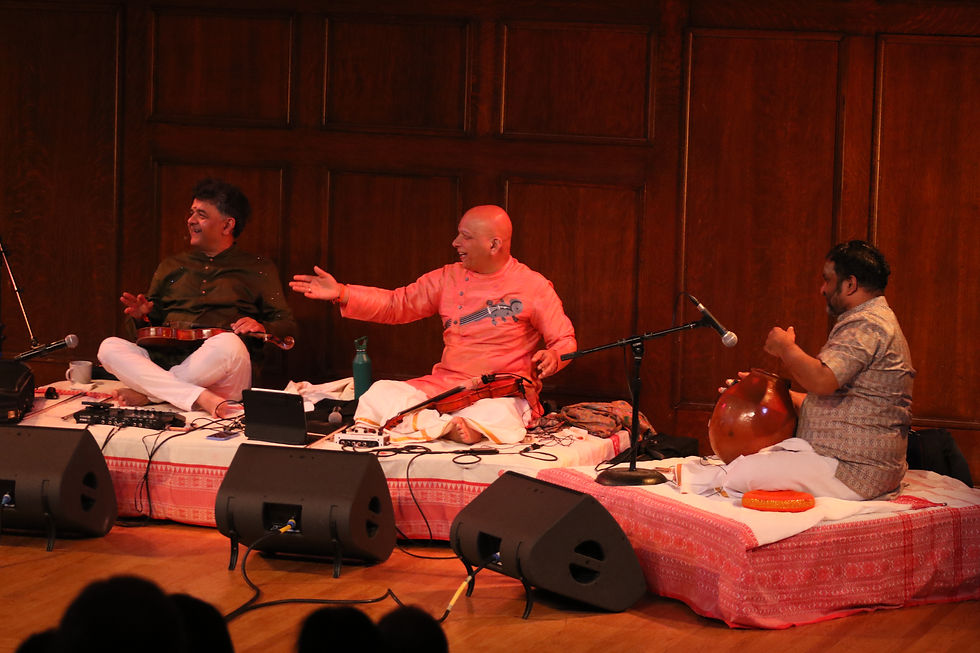
The stage itself was deliberately minimal. While there is a time & place for elaborate backdrops and stage decor, we felt that this event needed something much calmer. A soft spotlight kept the focus on the artists, and a simple set of lamps offered visual warmth, but nothing on stage competed with the music.

Several audience members noted how “centered” the performance felt — a direct result of the visual restraint.

Logistics were handled with equal clarity. From prompt parking updates (including a last-minute parking change conveyed by the venue) to program structure and emcee transitions, guests were guided seamlessly through the experience. As one attendee shared:
“The organization was impeccable — the concert started and ended exactly on time, and everything felt considered.”
Every step of the evening — from entry to post-show conversation — was intentionally paced and communicated.
Tailored for This Audience
The concert itself was shaped with equal care. In his opening remarks, Ramana offered an introduction to rāgas, microtonal movement, and the emotional architecture of Carnatic music — not as a lecture, but as a brief contextual frame for new listeners.
The selection of pieces reflected both range and accessibility. The repertoire balanced accessibility and depth. The main piece, a Rāgam–Tānam–Pallavi, was set in Desh. As Ramana explained:
“Because I was told that there would be a lot of listeners today that are not familiar with Carnatic music, I chose Desh, which is relatively accessible.”
He contrasted it with more complex ragas included elsewhere in the program:
“Some of the hardcore Carnatic ragams… have a lot of intricate nuances in the form of oscillations, which might be a little inaccessible at first… Those are absolutely beautiful, but it needs a little bit of growing on to happen for you to be able to appreciate that. So I thought I would do two hardcore pieces and then one piece which is a little more accessible.”
This sensitivity to audience familiarity — without compromising artistic depth — shaped the arc of the evening.
Other choices reflected cultural context: the performance of “Kaa Vaa Vaa” in Varali aligned with the day’s observance of Vaikasi Visakham, a Hindu holiday dedicated to the birth of Lord Muruga -- about whom the song was written. As one listener shared in a message afterward:
“The songs and the rāgams were so carefully chosen — the RTP was expansive and immersive, and it was especially meaningful to hear Varali on Vaikasi Visakham.”
Consultation & Collaboration
Since the event, we’ve been asked whether we offer design and curation consultation for other organizations. The answer is yes.
Whether it’s a one-time event or an ongoing series, we work with institutions, educators, and presenters who want to reimagine how classical arts are framed and shared. From spatial design to thematic programming, our work at Janya is grounded in creating experiences that are both grounded and expansive.
To explore partnerships or request a consultation, we’d love to hear from you.


Comments