
Mridangam
Mridangam
The heartbeat of Carnatic music — the mridangam is a two-headed drum unlike any other percussion instrument in the world, with a complex tonal range and rhythmic vocabulary that underpins every performance.

AT A GLANCE
Origin
South India
Root Language
Tamil / Sanskrit
Century
Ancient — mentioned in the Natyashastra (c. 200 BCE)
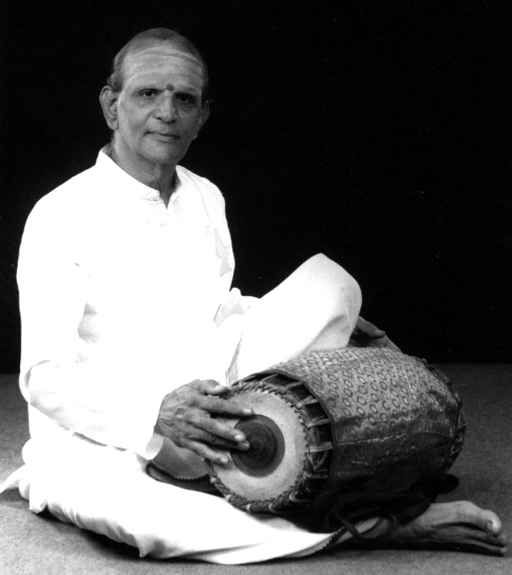
First, you become a rasika of the main artiste, whether vocal or instrumental. You must become the first rasika. And you must go into the music, so that it affects your psyche, your playing. The tempo, the voice, the volume, the mellifluousness, everything enters your body, and it reacts in the mridangam. Then, your reactions and movements will be in advaita bhava with the main artiste.
Umayalpuram K. Sivaraman, Padma Vibhushan
What Is
Mridangam
The mridangam takes its name from the Sanskrit mrid (clay or earth) and anga (body) — the earliest versions were made from hardened clay, before jackfruit wood became standard. It is a double-headed barrel drum, asymmetrical in design: the right head (valanthalai) is smaller and produces the higher-pitched sounds, while the left head (thoppi) is larger and produces a deep bass resonance. At the center of the right head is a black paste — a precise mixture of boiled rice, manganese powder, and iron filings, applied in layers — that gives the mridangam its characteristic harmonic ring and distinguishes it acoustically from any other drum in the world.
References to the mridangam appear in the Sangam literature of ancient Tamil — the Silappatikaram mentions it as part of the Antarakottu, a musical ensemble performed before dramatic performances. It appears in the Natyashastra and has been depicted in South Indian temple sculpture across millennia. The instrument has been the primary rhythmic accompaniment of Carnatic music since the tradition took its present form, and its relationship to the vocalist or main performer is one of the most carefully calibrated in any musical tradition. It is also utilized during dance performances within a similar context, interacting with the dancer as a rhythmic companion.
The mridangam's role in concert is threefold: it maintains the tala (rhythmic cycle) that gives the music its structure; it follows and responds to the melodic improvisation of the main artist in real time; and in the tani avartanam — the percussion solo section near the end of every major concert — it takes the lead entirely, displaying the full range of its mathematical and rhythmic vocabulary. This solo section is among the most technically demanding in any musical tradition in the world. Palghat Mani Iyer, one of the greatest mridangists of the 20th century, was the first to transform the instrument from a timekeeper into an active musical voice — one that could reproduce the subtleties and rhythmic complexities of a composition as a "rhythmic running commentary."
The two heads of the mridangam are tuned to different pitches — the right head (valanthalai) is tuned to the tonic of the raga being performed, while the left (thoppi) produces a bass tone. The right head is made with a permanent black patch of iron filings and rice paste that gives the mridangam its distinctive tonal ring — a sound completely unlike any other drum.
The percussion trinity of Carnatic music
Mridangam — the primary rhythmic instrument; both bass and treble in a single drum; the foundation of every concert
Ghatam — a clay pot percussion instrument; played with the hands, wrists, and fingers; the resonance is adjusted by pressing the open mouth against the belly
Kanjira — a small frame drum with a lizard-skin head; produces a wide range of tones
CONNECTED ON THIS SITE
SOURCE READING
India Art Review — T.K. Murthy: Doyen of Mridangam
Serenade Magazine — The Harmonic Beats: The Timeless Significance of the Mridangam
Sruti Magazine
KEY VOCABULARY
Talam — the rhythmic cycle the mridangam maintains and elaborates
Tani avartanam — the percussion solo, the mridangam's featured moment in a concert
Valanthalai — the right (high-pitched) head of the drum
Thoppi — the left (bass) head
Konnakol — vocal percussion, a parallel art form often performed alongside the mridangam
Korvai — a rhythmic phrase that resolves on the beat after a calculated number of repetitions
Solkattu — the spoken syllabic language of rhythm; how mridangam compositions are learned and transmitted
THE TRADITION TODAY
The mridangam has traveled far beyond the Carnatic concert hall. Leading performers now appear regularly on international stages — at festivals from Womad to Carnegie Hall — and collaborate across genres with jazz, world music, and contemporary classical artists. Maestro Trichy Sankaran, who joined the faculty of York University in Toronto, was among the first to establish the mridangam as a teaching and research instrument in Western academic music departments. Today the instrument is taught and studied in North America, Europe, Australia, and Southeast Asia, with a growing community of non-Indian practitioners — and the next generation is as international as it is South Indian.
